Quarter Zips Not Required (Sept '26)
Note from the Founders 👋
The Girl Math of Alternatives: The Alpha Nobody's Pricing In 👩💼
Deal Spotlight: Isle of Monday 👗
Investor Resource: Angel Investing 101 with Cheryl Kellond ✏️
Media & Press: Big Raises & Bigger Boardrooms 💰🎙️
What's Coming Up: Breakfast Bytes & Grocery Aisles 🛒
Closing Note 💌
Note from the Founders 👋
GM ☕ from Serena, Porter, and Emma! Fall is off to a hot start, and we're not just talking about NYC temperatures, which we honestly wish would be in the mid-sixties by now 😅. We're talking about the energy - fantasy football season kicking off (is it too late to start a GMC league?), Harry Styles taking over MSG for his residency, and cherry red and animal print officially back in style.
The best part: everyone's back from summer travel, which means Girl Math events are back too. We've already hosted the Show Her the Money screening in NYC, kicked off Cohort 4 IRL last night, and hosted SF walks, LA beach picnics, and Chicago happy hours, with much more on the calendar. WE BACK BABY! 🙌
Lots to get into this month, so we'll let the newsletter do the talking. Happy reading! 💸
The Girl Math of Alternatives: The Alpha Nobody's Pricing In 👩💼
Read time: ~6 minutes
When most people hear "hedge fund," they picture a very specific corner of Wall Street: huge minimums, complicated strategies, aggressive bets, and men in quarter-zips talking about "alpha" like it's a personality trait.
Some of that reputation is deserved. Hedge funds can be complicated, expensive, and notoriously opaque. But after our September Round Table with Kate Nevin, we came away with a much clearer understanding of what hedge funds actually are, why anyone bothers with them, and why female fund managers might be one of the more overlooked opportunities in the industry right now.
Kate is President and Portfolio Manager at TSWII Capital Advisors, where she runs a fund-of-funds investing in female General Partners, and she's also behind The Multiplier Effect Report, which tracks female investment talent across financial services. There’s no one better to learn from than her, so let's start with the basics.
First, what exactly is a hedge fund?
At its simplest, it's a privately managed pool of money that gives its manager more flexibility than a typical fund, with the goal of beating what you'd get just investing in the market. The category dates back to 1949, when Alfred Winslow Jones combined long and short positions, leverage, and performance fees into what’s now the blueprint for hedge funds. Jones would buy companies he believed would outperform and short those he believed would underperform, reducing his overall exposure to the direction of the market.
Today, hedge funds can invest across stocks, credit, currencies, commodities and more, using strategies ranging from long/short equity and event-driven investing to global macro and quantitative trading. They also have access to tools that a traditional mutual fund or ETF generally doesn't, including shorting, leverage, derivatives and more concentrated positions.
All of that flexibility is there to accomplish one main goal: generate alpha *mic drop*.
Alpha is the return a manager generates above and beyond what the market itself delivers. As Kate explained it, a hedge fund should be able to find returns that don't simply depend on the S&P going up. The market could be down 10% while a hedge fund is up 5%, 10% or even 20% because its strategy is finding opportunities on both sides of the market.
Of course, buying the index has worked pretty well lately too, which brings up the obvious question:
Why not just buy the S&P 500?
In recent years, an S&P 500 index fund has outperformed the average hedge fund. But the word average is important here.
Kate has invested in funds that doubled the S&P's return, others that matched it, and others that flopped. Unlike buying an index, where you're intentionally getting broad market exposure, investing in a hedge fund means making a bet on a particular manager's ability to find alpha.
Picking the right manager is, unsurprisingly, most of the job. She called due diligence "the single most important part of hedge fund investing," and her own bar is high: out of roughly 2,000 female managers in TSWII's database, she's invested in less than 1%. She looks closely at how returns were generated, how much risk and leverage a manager is taking, the fund's liquidity and fees, and the strength of the team behind it.
That level of diligence is tough for an individual investor to replicate, which is part of the appeal of a fund-of-funds: diversified exposure to several managers with the selection and diligence done for you.
Of course, that comes with another layer of fees. Hedge funds still carry the "2 and 20" reputation (2% management, 20% of profits), though Kate said fees have gotten more investor-friendly over her career. Her advice: look at net returns. High fees aren't automatically a dealbreaker if what's left over still beats the alternative.
The manager opportunity hiding in plain sight
If hedge fund investing ultimately comes down to finding exceptional managers, Kate thinks many investors are making a pretty glaring mistake in how they look for them: they aren't looking at enough women.
"If you don't have as many women in your pipeline for investing as you do men, then you're going to leave some money on the table," Kate told us. The data backs this statement up - the HFR Women Access Index tracks hedge funds in which a woman has significant risk-taking responsibility. The data Kate presented showed an up beta of 1.04 and a down beta of 0.58. In other words, the index has historically captured roughly the full upside of rising markets while participating in considerably less of the downside when markets fall. Kate calls this the "asymmetric advantage." The data doesn't mean every female hedge fund manager will outperform, or that being a woman somehow makes someone a better stock picker. What it does suggest is that investors who aren't seriously considering female managers may be unnecessarily shrinking their pool of talent.
Kate has spent years studying why that performance gap might exist, and one explanation in particular stuck with us.
Risk averse? Or just risk aware?
Women have long been described as more "risk averse" investors. Kate thinks we've been using the wrong phrase - her research suggests women are actually risk aware. Not afraid of risk, just insistent on deeply understanding it before they take it. That shows up as deeper diligence upfront and less panic-selling when the market temporarily turns - if the thesis hasn't changed, they tend to hold rather than trade in and out trying to time it. In a market where a handful of mega-cap tech stocks are carrying the S&P and AI is creating winners and losers at the same time, that kind of patience is a serious edge.
It's not just an individual trait, either. Kate's broader research has found that diverse investment teams tend to show stronger intellectual rigor overall. Different backgrounds and lived experiences mean fewer blind spots, since no two people are looking at the same investment through exactly the same lens.
For a fundamental long/short investor, that's a pretty interesting setup. You don't just have to figure out who wins the AI revolution. You can also make money figuring out who loses.
Yes, women should receive more capital, but they also need to control more of it.
As the founders of an investing community for women, we mention this stat every other day: all-female founding teams are receiving roughly 1% of U.S. venture deal value in 2026 (somehow down from 2% in prior years…). But the flip side of that statistic matters just as much: how little capital is actually managed by women. Those two problems are extremely related.
A woman writing her first $1,000 angel check and a woman allocating millions to a hedge fund are of course operating at very different scales. But getting more women investing is the first step toward getting more women allocating capital. Over time, some become LPs, join investment committees, work in venture or asset management, or launch funds themselves.
And the more women there are making investment decisions, the more perspectives and networks there are influencing where capital ultimately goes.
Kate sees that shift starting to happen in hedge funds. Women are leaving blue-chip firms and launching funds of their own, creating what she described as one of the most exciting generations of female hedge fund talent she has seen in her career.
If talented managers have historically been overlooked because they aren't part of the networks where capital typically circulates, finding them isn't just good for representation. It can also lead to… MORE ALPHA!
Deal Spotlight: Isle of Monday 👗
ICYMI: Each month, we'll share a few of the deals our community has backed, not to give investment advice, but to show you the breadth of opportunities Girl Math members are exploring and spotlight some epic founders.
It's becoming a pattern: we're scrolling Instagram, a celebrity look stops us mid-swipe, and it turns out, it's rented from Isle of Monday. Paige Lorenze at a tennis match in a vintage Emilio Pucci set. Laura Harrier in a 2000s Emanuel Ungaro dress that looks like it belongs in a museum, not a closet. The best part?! It can be yours too.
This month's spotlight is Isle of Monday: the first on-demand rental platform for women's luxury vintage fashion. Founded by archival fashion icons Gabriella Carota and Janelle Gray-Gilbert, Isle of Monday is on a mission to keep rare, well-made garments in circulation. What makes that possible is the tech behind their incredibly sourced collection: custom systems to authenticate and catalog one-of-one pieces and automate booking and returns in an industry that's historically run on DMs, invoices, and a lot of manual back-and-forth.
The thesis is bigger than a single trend cycle. US online resale is expected to nearly double to ~$40B by 2029, and vintage sits at the premium tier of that shift, with pieces that are non-replicable, culturally referenced by every new fashion cycle, and often priced out of reach for the everyday buyer. Isle of Monday's bet is that rental, not resale, is the real unlock: it gives people access to the rare and hard-to-find without the cost or commitment of ownership, and lets the same pieces serve new customers again and again instead of sitting unworn in one closet.
It's no surprise that over 25(!!!) women from the Girl Math Capital community invested in Isle of Monday, drawn to Gabriella and Janelle's deep knowledge of the space, their early traction and product-market fit, operational moat, and sustainability tailwinds. Among them is Kate Yarbrough, founder of T², a curated editorial and social platform sharing Top Ten lists from founders, tastemakers, and creatives.
Kate shared: "After investing in Isle of Monday, I wanted to find a way to support the brand beyond the investment itself. T² is a discovery platform centered around curation - connecting our community with the brands, founders, and products we genuinely believe in. Bringing T² and Isle of Monday together through an intimate NYFW dinner felt like such a natural extension of that." Powered by Uber, that dinner gave their creator community an exclusive first look at 300+ new fall arrivals before they went live on the platform.
Creators and celebrities drive a lot of the buzz around Isle of Monday's rentals, including Ines de Ramon at the US Open, Mary Beth Barone on the Golden Globes red carpet, Ashley Graham at NYFW, and Doechii on stage at the BET awards, but over 70% of their revenue still comes from everyday customers, meaning you really can get it too. And so can we - Emma rented a vintage Rampage power suit from the early 1990s for a speaking engagement, and Serena a Jean Paul Gaultier dress from 2001 for a wedding. Talk about range - Gabriella and Janelle, thanks for keeping us looking chic 💅.
Rent for yourself at isleofmonday.com, and follow along on Instagram.
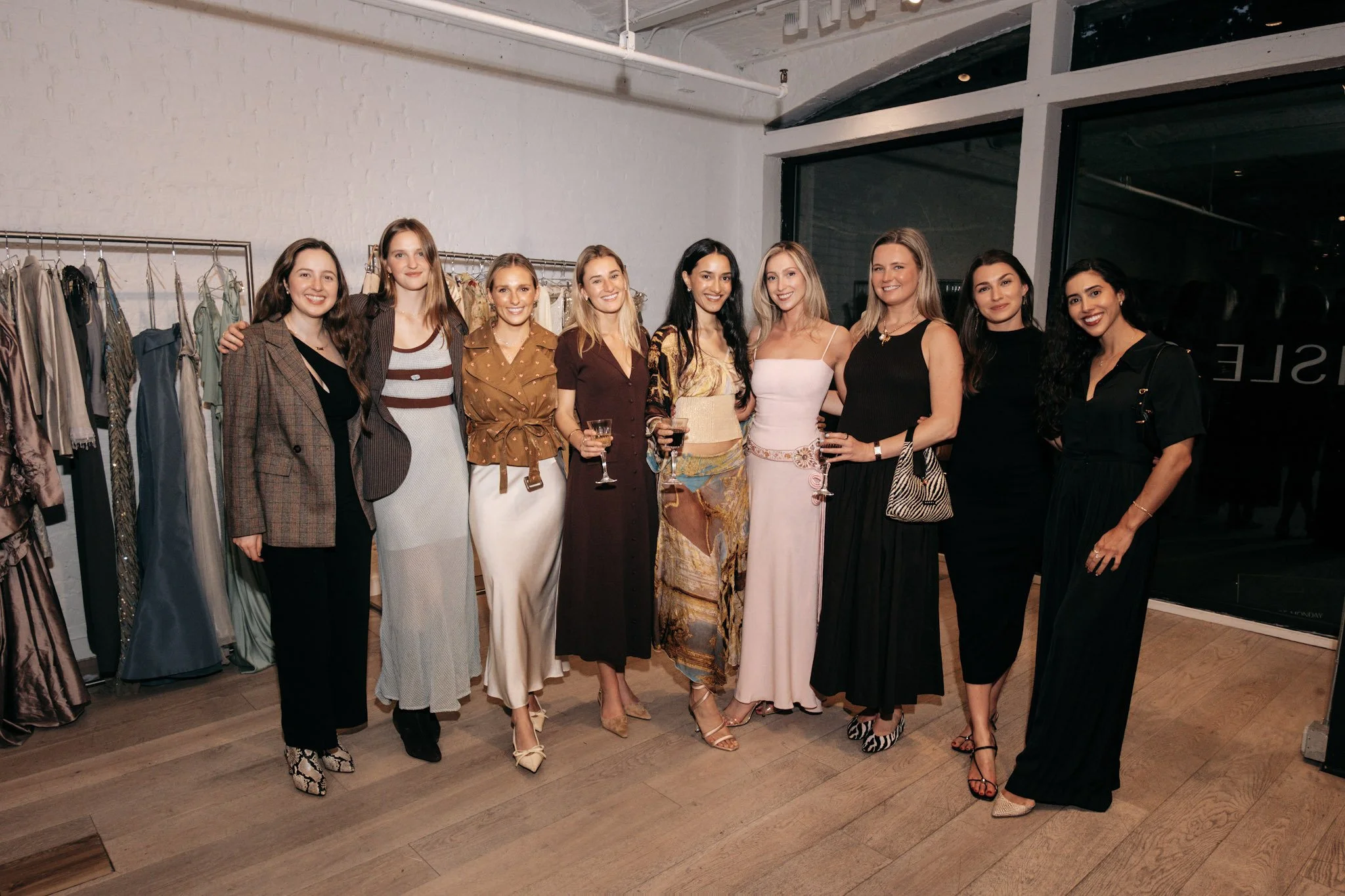
GMC investors at IOM’s launch night.



IOM x T² NYFW dinner powered by Uber.
Investor Resource: Angel Investing 101 with Cheryl Kellond ✏️
The angel investing block of our core curriculum always kicks off the cohort with the most energy. Yes, allocating money to companies you're passionate about might be THE coolest thing to do in investing, but the biggest driver of the fun is our guest speaker: Cheryl Kellond, founder and CEO of Play Money, an angel investing and SPV platform where the Girl Math community makes up the largest and most active investor group. Cheryl is a three-time founder, three-time Ironman finisher, parent of four, and personally manages 65 investments (35 direct, 30 through funds). She is also a riot, not to mention an amazing, authentic LinkedIn follow in a sea of AI slop.
You'll have to join our next cohort to get the full scoop, but here are a few of the biggest takeaways from this session:
1. Portfolio size matters more than picking winners. Data from AngelList suggests that the number of bets you make predicts your outcomes more reliably than your ability to pick the right company. Cheryl's benchmark is to aim for around 30 investments spread across five to six years, enough to diversify across market cycles, not just companies.
2. The return distribution is genuinely lopsided - don't freak out. Data from 500 Startups shows roughly 50% of early-stage investments return zero, 40% return 1-3x, about 8% return 10-50x, and just 1-2% become the outliers that drive most of the actual performance. Angel investing isn't gambling, but it only works as a strategy at the portfolio level, not the single-bet level.
3. Know your instruments. Startup fundraises typically use one of three structures: a SAFE, a stock purchase agreement, or a convertible note. Depending on your check size, you might invest directly on the cap table, pool capital through an SPV, or come in as an LP in a fund and let a manager handle the logistics.
4. Size your allocation thoughtfully. Cheryl's rule of thumb is 5-7% of net worth allocated to a diversified basket of startups, divided across roughly 30 bets, and she noted some investors use retirement accounts for this (with a caveat: watch for deals structured as LLCs, which can trigger Unrelated Business Taxable Income and complicate a retirement account's tax treatment; Play Money flags these proactively).
5. Patience is the actual price of admission. Expect an 8-12 year timeline for returns, and be ready for the "J-curve," where your early failures show up well before your winners do.
Consider this your cheat sheet until you can get the real thing. See you in our next cohort 👋
Media & Press: Big Raises & Bigger Boardrooms 💰🎙️
This past month, we shared our POV on a question a lot of women run into the moment they learn they're getting a raise: how can I upgrade my lifestyle while still making the most of the money? Lifestyle creep is real - a 2025 Goldman Sachs survey found that the more some people make, the more stretched they tend to feel. We wrote a piece for Frich, a mobile app and social finance platform helping Gen Z take control of their money, explaining how we'd think about the pay bump. Read the full article here.
Just this week, Emma joined a live panel-turned-podcast for Startups Decoded hosted by Andy Walsh alongside Elizabeth Vincent (J.P. Morgan Asset Management) and Breen Sullivan (The Fourth Effect), in front of 60+ founders. They got into the early decisions founders treat as reversible but usually aren't: when your first board seat should happen, when to formalize an advisor into an investor, and how term sheet structure quietly shapes control before you ever feel it. Listen on Spotify or Apple Podcasts 🎧
What's Coming Up: Breakfast Bytes & Grocery Aisles 🛒
On Wednesday, September 23rd from 8-10am ET, we're hosting an AI Breakfast for female founders and early operators in NYC, in partnership with MOXIE. Alongside iced coffees and breakfast parfaits, we’re getting hands on with Town, an AI assistant that handles inbox, scheduling, and admin. Big thanks to Hire Tomorrow, Ramp, and Town for making it happen. RSVP here.
The next night, on Thursday, September 24th at 7pm ET, we're turning grocery aisle into deal flow, bringing together investors, founders, and CPG operators at NYC’s most beloved boutique grocer. Join us alongside Myca Collective for an industry night at Pop Up Grocer, made possible by Brex and Wispr Flow. RSVP here.
Lastly, follow us on LinkedIn, Instagram, or TikTok so you don't miss a thing.
Closing Note 💌
Girl Math Capital was born from the frustration that deals were shared in some circles and not in others. This newsletter is one more way to make sure those conversations and opportunities reach more people, and in particular, more women. If you know someone who'd love this newsletter, pass it along. We believe alternative investing isn't just for finance and tech bros - it's for women who want to get smart, build community, and create generational wealth. See you next month 💸💅
The Girl Math Team
If this got you curious, submit your information to join our next cohort, or apply to be a community member here.